
What Is a 990-N? 2026 Filing Guide
Learn what is a 990-N, who must file it, and deadlines that matter. Practical guidance for church finance teams to stay compliant.
Form 990-N, also called the e-Postcard, is the IRS's simplest annual filing for small tax-exempt organizations with gross receipts normally $50,000 or less. A calendar-year church generally has to file it by May 15, and it can't be filed until after the tax year ends.
About Grain Ledger: This guide includes Grain Ledger, church fund accounting software built for designated gifts and ministry funds. It connects giving platforms (Planning Center, Pushpay, Tithely, Stripe), syncs bank activity with Plaid, and produces fund-level financial reports. Start free to see how it compares for your church.
See Grain Ledger for your church
Fund accounting, giving integrations, and bank reconciliation in one platform. Free migration support for churches switching from QuickBooks or Aplos.
A new treasurer often opens the IRS notice and sees a term that sounds more technical than it is. The pressure usually comes from the same place, a small church has a few income streams, a stack of ministry funds, and one annual compliance task that nobody wants to miss.
Understanding Form 990-N for Small Churches
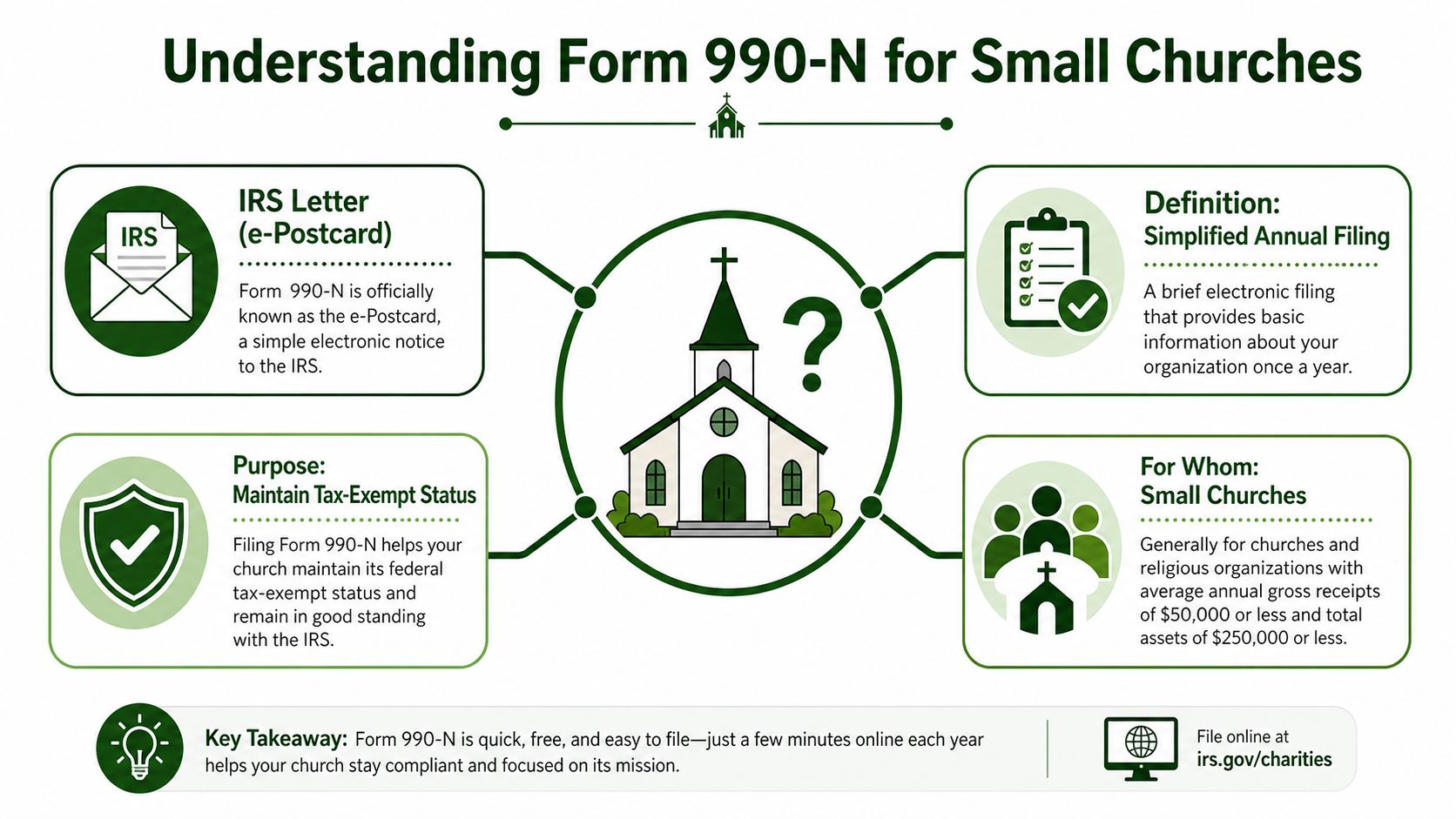
The first time a church treasurer sees the word e-Postcard, it can sound like the IRS is asking for something informal. It isn't. Form 990-N is the IRS's annual electronic notice for small tax-exempt organizations, and it exists to keep smaller ministries in compliance without forcing them through a longer return they do not need. The IRS says it is filed entirely online, with no paper form, and it asks for only eight basic items of information. IRS Form 990-N e-Postcard filing guidance
A church finance committee can view it as the shortest federal yearly report in the 990 family. It captures identity details, the tax year, and a confirmation that the organization is still within the qualifying threshold, rather than full financial line items. That limited scope is the point, because the IRS designed it to preserve compliance for smaller nonprofits while minimizing reporting burden.
Practical rule: if your church qualifies, 990-N is still required. It is a simpler annual filing, not an optional one.
A newly appointed finance chair may ask why the IRS created a filing this short at all. The answer is straightforward. Small ministries still need a clean compliance trail, but not every congregation has the volume or complexity that calls for a full return. A church treasurer may hear 990-N described as a small form with a big responsibility.
For teams keeping ministry documents in one place, document tools for NGOs can also help organize policy files, board records, and tax paperwork alongside the filing itself.
Determining Whether Your Church Qualifies for 990-N
A church's eligibility for 990-N starts with one figure, gross receipts. In a church setting, that means the money the organization receives from ordinary ministry activity, such as tithes, offerings, special gifts, rental income, and other revenue that belongs to the church before expenses are paid. If the records show those receipts are normally $50,000 or less, the IRS treats 990-N as the filing path for the church. IRS Form 990-N FAQs
Start with the receipts, not the expenses
A common mistake is to check whether the church spent less than a certain amount. That is the wrong test. The IRS looks at gross receipts, not what remains after payroll, utilities, missions giving, or building repairs.
For a treasurer, that means every incoming dollar matters. A building rental payment, a special anniversary offering, or a one-time designated gift still belongs in the gross receipts conversation if it is part of the organization's revenue. If the church uses fund accounting, each receipt is easier to trace because the income is tied to the right fund from the start, which helps the committee compare the books with the IRS threshold without guessing.
“Normally” means the pattern matters
The IRS uses the phrase normally $50,000 or less for the threshold, so churches need to look at the organization's regular receipts pattern, not just one unusual week. A single generous gift can make a year look larger than it really is, but the filing category still depends on the IRS threshold test, not on a donor's one-time moment of generosity.
A church plant in its first year, a congregation with a rental agreement, or a ministry that received an unusually large restricted contribution should slow down and review the numbers carefully. The IRS instructions for Form 990 explain the threshold and filing rules in more detail. If the receipts trend stays within the threshold, 990-N remains the fit. If the church is no longer within that range, the filing obligation changes to a longer form.
If the receipts picture is unclear, the books need to be reconciled before anyone starts the return. Guessing is how churches file the wrong form.
A finance committee that keeps income, restricted gifts, and designated funds organized in one system has a much easier time proving whether the church qualifies. Grain Ledger helps remove the guesswork by keeping receipt categories visible, so the team can check the gross receipts total against the filing threshold and make the filing decision with confidence.
How 990-N Compares to Form 990 and Form 990-EZ
Church boards sometimes treat all 990 filings as one category, but the forms serve different reporting levels. The difference is not just length. It also shows up in how much financial detail the IRS expects, how much staff time the return takes, and whether the church fits the filing category at all.
| Criteria | Form 990 | Form 990-EZ | Form 990-N (e-Postcard) |
|---|---|---|---|
| Filing level | Full return | Shorter return | Minimal electronic notice |
| Gross receipts fit | Higher-receipt organizations | Mid-range organizations | Organizations normally at $50,000 or less |
| Data required | Detailed financial and governance information | Less detailed than Form 990 | Only basic organizational items and threshold confirmation |
| Filing burden | Highest | Moderate | Lowest |
| Disclosure level | Extensive | Limited compared with Form 990 | Very limited |
Form 990-N sits at the simplest end of the range because it asks for identity information, the filing period, and confirmation that the church stays within the threshold. It does not require line-by-line financial reporting. For a church treasurer already balancing weekly deposits, donor statements, and restricted funds, that lighter reporting load can make the annual filing easier to prepare.
A finance committee may still wonder whether a church can pick a longer form even if it appears to qualify for 990-N. The core question is whether the church is required to file a different return because of its size or organizational status. If the church does not meet the conditions for 990-N, filing the shorter notice does not satisfy the annual requirement.
Churches that want a clearer picture of how filing categories fit into their recordkeeping can use annual information return guidance as a reference point while they compare the return types and check whether their books support the filing choice.
Filing Deadlines and Required Information
A church treasurer who closes the books in January or February may feel ready to file, but Form 990-N waits for the tax year to end first. The filing window opens after year-end and closes on the 15th day of the 5th month after the close of the tax year, so a calendar-year church generally files by May 15. The IRS also requires electronic filing for this notice, which means the return is submitted online, not mailed in a paper packet. IRS Form 990-N e-Postcard filing guidance
The eight items you need
The IRS says the filing asks for only eight basic items. Those include the organization's EIN, legal name, mailing address, principal officer, website, tax year, and confirmation that gross receipts fit the threshold. IRS Form 990-N e-Postcard filing guidance
That short list is a relief for churches that already track offerings, restricted gifts, and designated funds in their accounting records. The primary work is not gathering piles of forms, it is making sure the details match the current records. If the principal officer changed during the year, the filing should name the correct person. If the mailing address changed, the notice should reflect where the IRS can reach the church.
Build the filing into your calendar
The easiest way to handle 990-N is to fold it into year-end close, right alongside bank reconciliation and review of the church ledger. Once the books are settled, the filing details are easier to verify, and the finance committee is less likely to rush at the last minute.
A church can also keep the deadline on the same calendar used for budget planning and board meetings. That helps because the deadline is fixed, but the people responsible for remembering it may change from year to year.
For a step-by-step operational reference, the church can also review annual information return guidance while preparing the records needed for the filing, and a guide to IRS penalty removal can help leaders understand what to do if a filing problem has already started.
Penalties and Consequences of Missing Your Filing
Missing a 990-N deadline is not just a paperwork issue. The IRS rule that gets church leaders' attention is the three consecutive years standard, because failure to file for three straight years can trigger automatic revocation of tax-exempt status. IRS Form 990-N e-Postcard filing guidance
That consequence reaches far beyond the return itself. If a church loses exempt status, the board may have to deal with donor confusion, state-level filing complications, and the work of restoring the organization's standing. Reinstatement takes time, so the simplest solution is still the best one, file on time every year and keep proof that the filing was submitted.
Common mistakes that cause missed filings
Churches usually miss 990-N for ordinary reasons, not dramatic ones. Someone assumes churches never file anything with the IRS. The tax year gets confused with the calendar year. Or the responsibility lands on a new volunteer who doesn't know the deadline is fixed.
The problem gets worse when no one owns the process. If a treasurer leaves midyear and the next person doesn't know whether the filing was made, the church can lose valuable time checking instead of submitting. A simple handoff checklist avoids that gap.
If a deadline has already been missed, it can help to review a guide to IRS penalty removal so the team understands what relief, if any, may exist in a broader tax situation. That kind of review doesn't replace timely filing, but it can help leaders respond calmly if a year was overlooked.
The safest mindset is to treat 990-N as a standing compliance duty, not a low-priority form because it's short. Short forms still carry real consequences when nobody files them.
How Fund Accounting Simplifies 990-N Compliance
The hardest part of 990-N isn't the electronic submission. It's knowing the church's gross receipts with confidence before the filing season begins. That's where fund accounting makes the difference, because every receipt is tied to the right fund and the finance team can see totals without rebuilding the numbers from scratch.
Why integrated records matter
A church doesn't just track one bank balance. It tracks general giving, designated funds, missions activity, building money, and other restricted dollars that all need to stay organized. Grain Ledger uses native fund architecture so transactions, reports, and balances are organized around funds from the start, and it unifies the giving platform, bank accounts, and accounting system so donations flow into the correct funds automatically. That reduces manual reconciliation and gives treasurers clearer visibility into total gross receipts as the year unfolds. What is fund accounting system
That kind of structure matters because 990-N eligibility depends on the gross receipts threshold, not on a rough estimate or a spreadsheet pulled together at year-end. If the accounting system already separates restricted giving from other receipts correctly, the committee spends less time debating the number and more time verifying it.
Real-time visibility changes the filing conversation
When the books are organized by fund, a treasurer can see the filing picture earlier. That means the finance committee can notice when receipts are trending close to the threshold and prepare for a different return if needed. It also helps when leadership changes, because the reporting system itself carries the history instead of relying on one person's memory.
A church doesn't need more guessing. It needs books that show the receipts clearly enough to support the filing decision.
If your church wants one accounting solution to evaluate, Grain Ledger is worth considering because it's built around fund-based church accounting and direct integration with the systems churches already use. That doesn't replace human review, but it does remove a lot of the uncertainty that usually surrounds 990-N preparation.
Related church accounting software resources
If you are comparing software, these pages map the main decision points: fund accounting, QuickBooks limits, pricing, and migration.
- Best church accounting software (2026 comparison) - canonical guide comparing 12 church accounting platforms
- Church accounting software product page - see Grain Ledger for fund accounting, giving, and bank reconciliation
- Small church accounting software - see the product page built for volunteer treasurers and church admins
- Fund accounting features - review how Grain Ledger tracks designated funds
- QuickBooks for churches - understand workarounds and when to switch
- Free church accounting software - compare free options and upgrade triggers
- Grain Ledger pricing - compare plans for small and growing churches
- Start free - try fund accounting, giving imports, and bank reconciliation together
Your Church 990-N Compliance Checklist
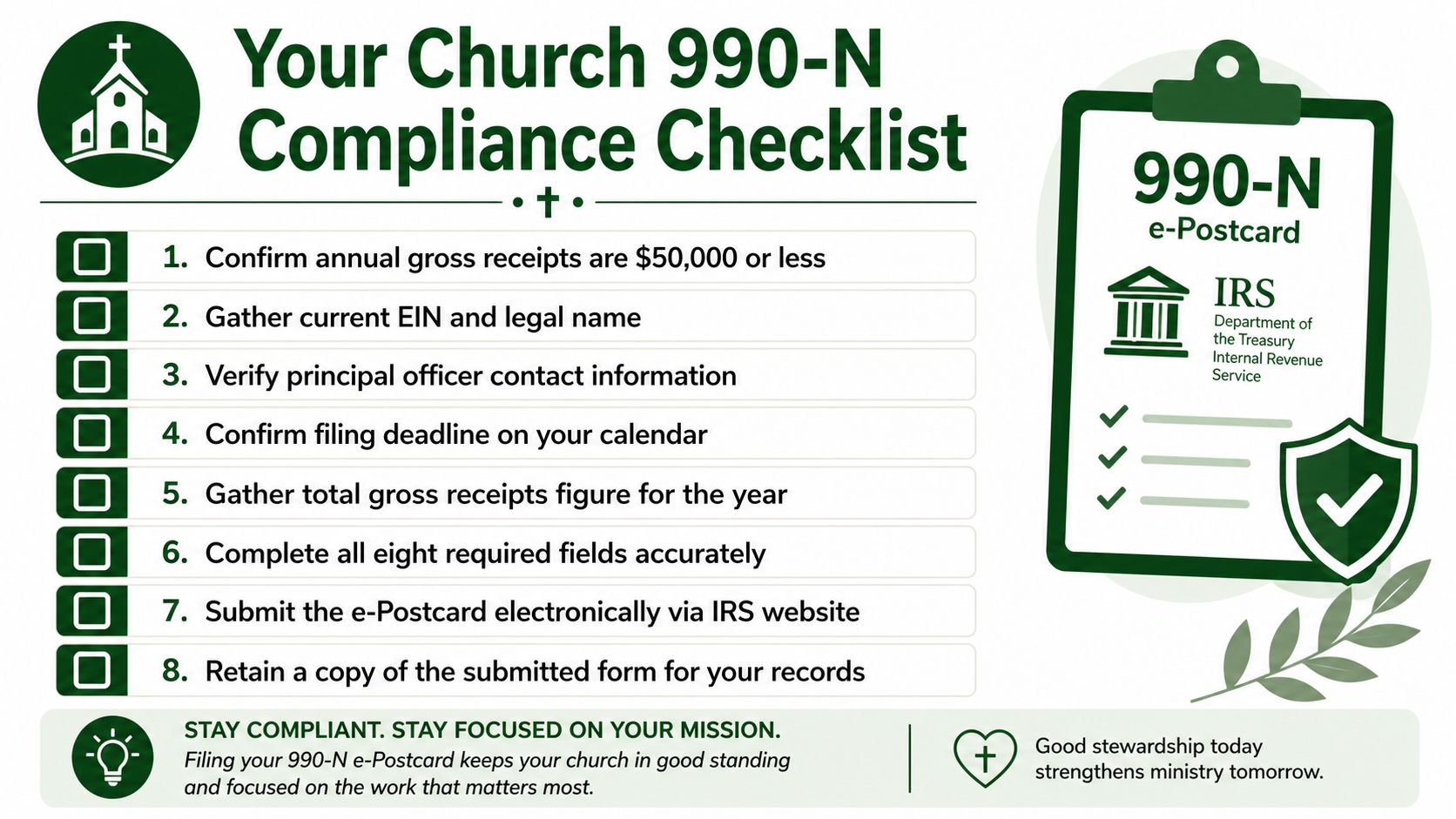
A good church filing process should feel repetitive in the best way. The team checks the same items every year, the deadline stays fixed, and nobody has to rebuild the process from memory.
- Confirm the threshold first: Verify that gross receipts are normally $50,000 or less before anyone starts the filing.
- Gather the church identity details: Pull the EIN, legal name, mailing address, and principal officer information.
- Check the calendar: Mark the filing date as the 15th day of the 5th month after year-end.
- Review the year's receipts: Make sure the total matches the books, not a quick estimate.
- Enter all required information carefully: The IRS wants the filing complete and accurate, even though it's short.
- Submit electronically: File the e-Postcard through the IRS system after the tax year closes.
- Save proof of filing: Keep a record of the submitted form for the church file.
- Watch for red flags: A spike in donations, a new principal officer, or a new EIN deserves extra attention.
For churches building a broader annual compliance rhythm, nonprofit compliance checklist guidance can help connect the tax filing with board records, internal controls, and recurring deadlines.
If your church wants cleaner books and less anxiety around IRS filing season, Grain can help you organize funds, track receipts accurately, and keep compliance visible all year long. Visit Grain to see how fund-based accounting supports the records your team needs for Form 990-N and the rest of your annual workflow.
Ready to simplify your church finances?
Start free with church fund accounting, or watch a product demo first.