
What Is Vision Casting for Church Leaders
Discover what is vision casting and how church leaders use it to align congregations, inspire action, and connect ministry goals to financial stewardship.
Vision casting is the ongoing leadership practice of creating and communicating a clear, compelling picture of a desired future that aligns a congregation around a shared mission and motivates coordinated action. It turns a church's abstract purpose into a future people can understand, embrace, and pursue together.
About Grain Ledger: This guide includes Grain Ledger, church fund accounting software built for designated gifts and ministry funds. It connects giving platforms (Planning Center, Pushpay, Tithely, Stripe), syncs bank activity with Plaid, and produces fund-level financial reports. Start free to see how it compares for your church.
See Grain Ledger for your church
Fund accounting, giving integrations, and bank reconciliation in one platform. Free migration support for churches switching from QuickBooks or Aplos.
A pastoral team may recognize the problem immediately. The church calendar is full, volunteers are working hard, ministries are meeting their schedules, and giving is being processed. Yet children's ministry, missions, worship, small groups, and outreach can all move in separate directions. People are busy, but they aren't always moving toward the same future.
Vision casting helps close that gap. It gives leaders a way to name where God is calling the church, explain why that future matters, and connect everyday decisions to the congregation's shared mission. The practice becomes especially useful when it joins spiritual direction with practical execution, including ministry priorities, decision-making, and financial stewardship.
Understanding the Purpose of Vision Casting
A church can have excellent programs and still lack a common direction. One ministry may focus on welcoming young families, another on neighborhood outreach, and a third on deep discipleship. Each effort may be worthwhile, but without a shared picture of the future, leaders often compete for volunteers, attention, and funding rather than reinforcing one another.
Vision casting addresses that fragmentation. Vision casting in church leadership means creating and communicating a clear, compelling vision that inspires and unifies people toward a common goal, giving the congregation shared purpose and direction. ACS Technologies describes vision casting in church leadership in these terms, emphasizing the way a shared vision gives people direction rather than leaving each ministry to define success independently.
Vision is more than a statement
A vision statement might fit on a page, but vision casting is not limited to writing that statement or presenting it once from the pulpit. Leadership materials describe it as an ongoing practice of creating and communicating a desired future that motivates people to act. Churches reinforce that future through sermons, stories, meetings, written materials, personal conversations, and repeated reminders.
That distinction matters. A statement may describe the destination, while vision casting helps people understand why the destination matters and what faithful participation looks like today.
Practical rule: If people can repeat the vision but can't explain what it changes in their ministry, schedule, or decisions, the church has a slogan, not yet a functioning vision.
The bridge from mission to action
Most churches already have language about worship, discipleship, service, or making disciples. Vision casting gives those broad commitments a recognizable shape. It answers questions such as:
- What future are we pursuing? Describe the desired end-state in language people can picture.
- Why does it matter now? Connect the future to a spiritual need, calling, or opportunity.
- What will change? Identify the behaviors and priorities that should look different.
- How can people participate? Give members, volunteers, and leaders a clear next step.
A pastor might say, “We want to be a church where every neighborhood family can find belonging, hear the gospel, and grow in community.” That sentence becomes useful only when leaders connect it to hospitality training, small-group development, children's ministry capacity, outreach partnerships, and the way the church allocates its resources.
Vision casting therefore moves in both directions. It lifts people's eyes toward a preferred future, then brings that future back into ordinary choices. The worship leader, treasurer, volunteer coordinator, elder, and small-group leader should each be able to see how their work contributes to the same mission.
The Core Elements of a Compelling Church Vision
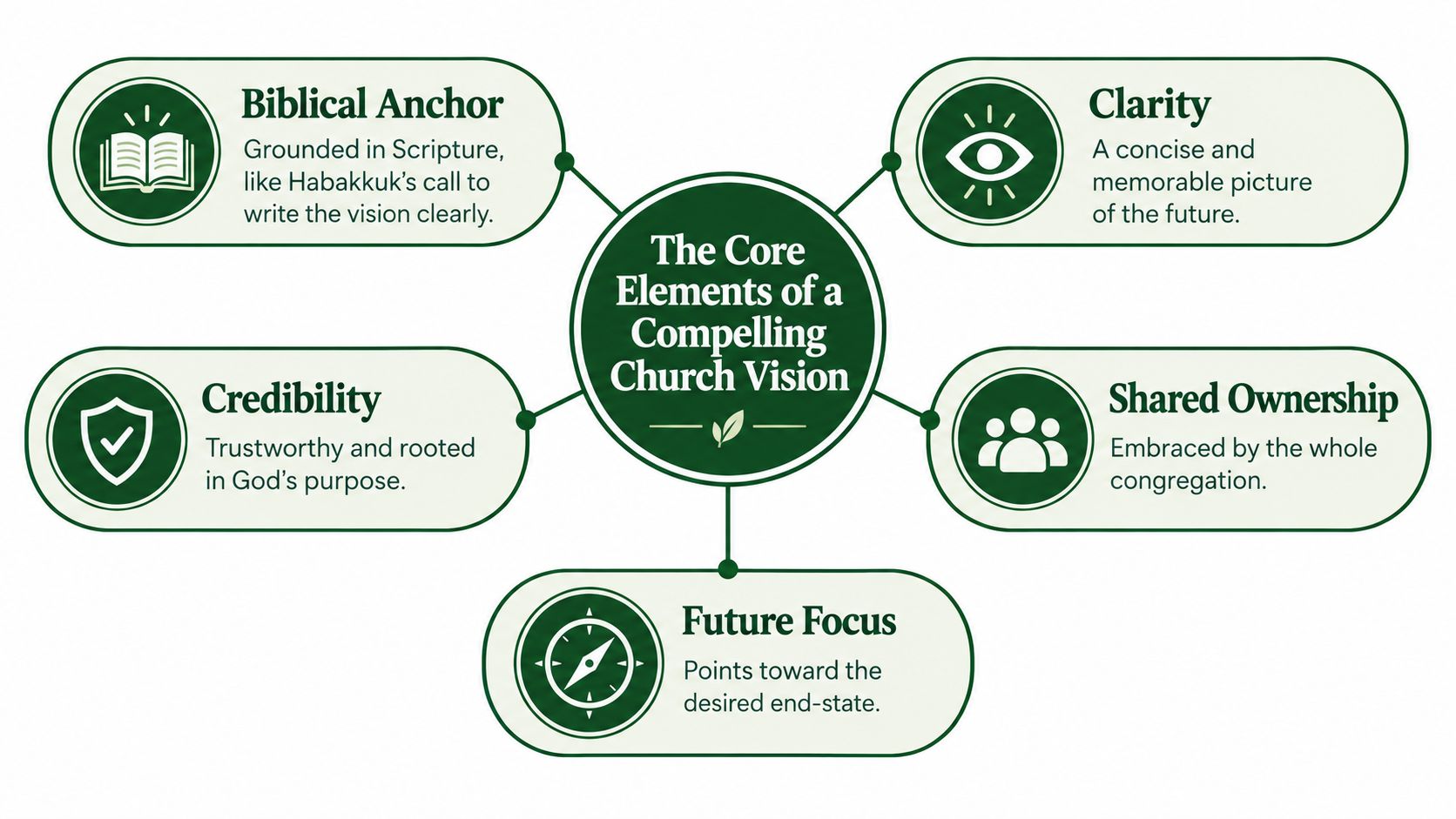
A compelling church vision begins with spiritual grounding, but spiritual language alone doesn't make a vision clear. Leaders must also help people understand the future, trust the direction, recognize their place in it, and know how the church will make decisions along the way.
A commonly cited biblical anchor is Habakkuk 2:2, which says to write the vision and make it plain. The instruction connects vision with clarity and accessibility. A vision that remains only in a leader's private prayer life cannot guide a congregation. Writing it down gives the church something it can examine, remember, discuss, and apply.
Five qualities leaders should test
Biblical anchor means the vision reflects the church's calling under Scripture rather than expressing a pastor's preferred project. Prayer, biblical discernment, and theological integrity protect the congregation from confusing personal ambition with ministry direction.
Clarity means people can understand the future without needing a long explanation. A clear vision uses memorable language and avoids stacking several unrelated ambitions into one statement.
Credibility means the congregation can trust both the spiritual basis and the leadership process behind the vision. Leaders build credibility when they acknowledge constraints, explain tradeoffs, listen to concerns, and show how decisions will support the stated direction.
Shared ownership develops when people see their ministry, gifts, and responsibilities within the future being described. Leaders shouldn't assume that announcing a vision creates ownership. They cultivate it through conversation, participation, feedback, and visible alignment.
Future focus keeps the church from confusing current activity with ultimate progress. A church may continue familiar programs while still asking whether those programs move the congregation toward the desired end-state.
How the practice developed
Vision casting has been formalized in church leadership materials for at least two decades. A 2005 Journal of the American Society for Church Growth article emphasized practical actions such as writing the vision, understanding the audience, and continually promoting possibilities. The journal article on vision casting shows that the practice was already being treated as an operational church-growth discipline rather than only as inspirational language.
Later training materials described the process through a sender, a message, and a receiver. They also recommended multiple forums, repetition, and written publication. More recent guidance presents vision casting as the art of creating a mental image of a future that should exist but doesn't yet, then adapting the message through individual conversations, stories, and feedback.
Modern leadership guidance also connects vision communication with a framework of establishing direction, securing commitment, and energizing people. The historical movement is important for pastoral teams: vision casting began as a church-growth strategy and developed into a broader discipline that joins spiritual purpose, communication, participation, and execution.
How Leaders Create and Cast a Clear Vision
Leaders often begin with a phrase such as “We want to reach more people” or “We need deeper discipleship.” Those concerns may be sincere, but they don't yet describe a future that a congregation can picture or use to make decisions. A practical process helps the team move from concern to direction.
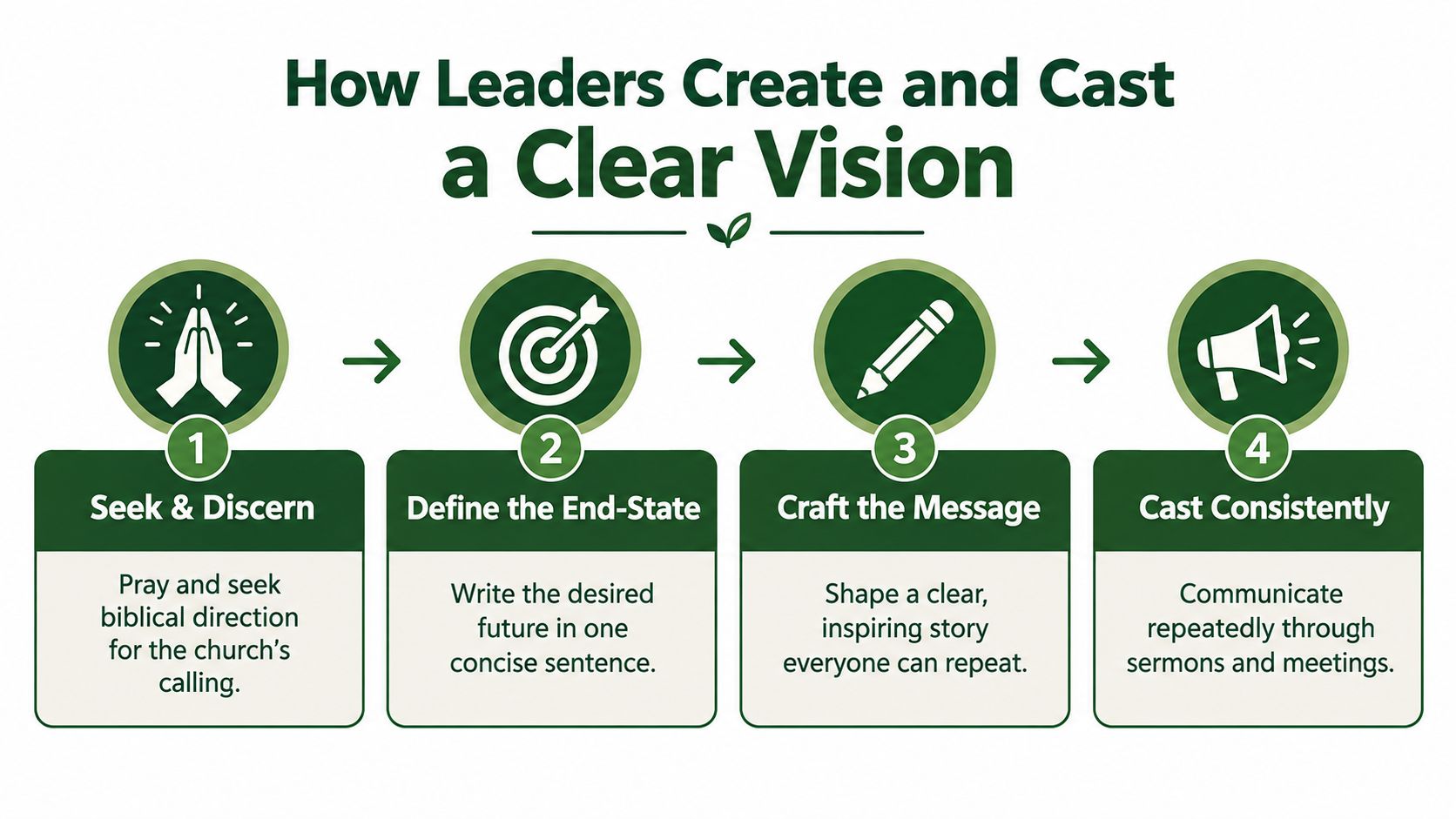
Start with prayer and discernment
Before drafting language, leaders should seek biblical direction for the church's calling. Ask what the congregation is uniquely positioned to address, what needs require faithful attention, and what future would reflect the church's mission rather than merely its preferences.
This discernment should include the pastoral team and appropriate ministry leaders. Listening together can reveal where the church already sees evidence of God's work and where members feel a persistent burden or calling.
Define the end-state in one sentence
Write the desired future in one concise sentence. The sentence should describe what will be different because the church has faithfully pursued its calling. Avoid turning the statement into a list of activities. “We will launch a class, create a team, and host an event” describes a plan. “We will become a church where...” begins to describe a future.
A concise statement also creates a test for future proposals. If a new ministry cannot be connected clearly to the vision, leaders can ask whether it belongs in the current season.
Build the decision architecture
Vision becomes operational when leaders explain how decisions connected to it will be made. A useful framework answers:
- Who decides? Identify the pastor, elders, ministry leaders, finance team, or congregation involved.
- How is the decision made? Clarify whether leaders seek consensus, receive recommendations, or follow a defined approval process.
- When is it finalized? Set a clear point at which discussion becomes action.
- How is it communicated? Decide which groups need the decision, its rationale, and its implications.
- How is accountability maintained? Establish how leaders will review progress, report results, and respond when plans change.
This structure prevents the vision from becoming a slogan disconnected from governance. Christian Leadership Alliance's guidance on vision casting emphasizes this connection between a desired end-state and the written process that governs decisions, communication, and accountability.
Pastors who want to deepen this work should also connect vision casting with biblical leadership development, especially when developing leaders who can carry the church's direction into ministries beyond the pulpit.
A useful internal resource for connecting leadership character with ministry practice is Grain Ledger's guide to the characteristics of biblical leadership. Use it as a conversation starter with elders and ministry leaders, not as a substitute for prayerful discernment.
Shape the message for real people
The final message should be clear, concise, compelling, challenging, and credible. Use one memorable sentence, a story that illustrates the need, a biblical connection, and a practical invitation. Then revise the message as leaders hear questions and observe where people misunderstand it.
The following video can help a pastoral team think about the relationship between leadership communication and coordinated action.
Vision casting isn't complete when the message sounds polished. It becomes effective when people know what the future means, how decisions will support it, and what faithful participation looks like in their own ministry.
Communicating the Vision Across the Congregation
A congregation doesn't catch a vision merely because the pastor announces it. People need to hear the message in settings where they can ask questions, connect it to their ministry, and see evidence that leaders are following through.
The message should be clear, concise, compelling, challenging, and credible. Clarity helps people remember it. Concision keeps the central idea from disappearing inside a long explanation. A compelling message connects with the heart, while a challenging message calls people toward meaningful participation. Credibility grows when leaders show that the vision reflects Scripture, acknowledges reality, and guides actual decisions.
Begin with a guiding coalition
Start with early adopters and a trusted guiding coalition. This group may include pastors, elders, ministry directors, staff, and respected volunteers. Their role isn't to become an exclusive inner circle. They help test the language, identify confusion, model participation, and surface concerns before the wider rollout.
Then expand to key influencers. Small-group leaders, children's ministry volunteers, worship leaders, deacons, and ministry team coordinators often shape how the wider congregation interprets a new direction. Meet with them personally and ask:
- What part feels clear? Keep language that people can repeat naturally.
- What feels unrealistic? Address credibility concerns rather than dismissing them.
- What would this change in your ministry? Translate the vision into behavior.
- What questions will members ask? Prepare honest answers before the public launch.
Finally, communicate to the wider congregation with an explicit call to action. The rollout should feel like an invitation into shared obedience, not an executive announcement delivered from a distance.
Use stories and repetition
Stories help people see the future through recognizable people and moments. A volunteer welcoming a new family, a small group serving a neighborhood, or a disciple taking responsibility for another believer can make an abstract direction tangible. Leaders should use stories more often than statistics when the goal is emotional connection and shared imagination.
For help developing narrative skill, pastors may find these 10 storytelling techniques for growth useful when adapting stories for sermons, volunteer meetings, or ministry updates. The techniques should serve the church's message rather than turn ministry communication into entertainment.
Repeat the vision across multiple forums:
- Sermons and worship gatherings should connect the vision to Scripture and the church's identity.
- Leadership meetings should use the vision to evaluate priorities and decisions.
- Volunteer training should show how service contributes to the future.
- Written communication should reinforce the same language after people leave the room.
- Progress stories should show where the church sees movement and where it needs patience.
A helpful resource for aligning these settings is Grain Ledger's perspective on communication in the church. The central discipline is consistency. Leaders don't need to repeat the same speech, but they should preserve the same meaning.
Vision becomes part of congregational culture when members hear it, see it in decisions, and experience it through ministry.
Connecting Vision to Financial Stewardship and Fund Priorities
A church can communicate a beautiful vision and still fail to pursue it if the budget, restricted funds, staffing choices, and ministry calendar point elsewhere. Financial stewardship reveals what the organization is prepared to support. If the vision names a priority but the financial system cannot show whether resources are reaching that priority, leaders are left with aspiration rather than accountability.
Fund accounting provides the needed connection. Churches don't manage one undifferentiated pool of money. They may receive gifts restricted for missions, building work, benevolence, youth ministry, or another stated purpose. Leaders must know which funds are available, which are restricted, what has been spent, and whether ministry activity matches donor intent.
Turn the vision into resource decisions
Suppose a church's vision emphasizes forming disciples through neighborhood groups. The operational questions become concrete:
- Which ministry expenses directly support group formation?
- Who owns the related decisions?
- Which funds may legally and ethically support those expenses?
- What reports will elders review?
- How will leaders explain progress to the congregation?
These questions don't reduce ministry to finance. They protect the church from making spiritual promises that its operating practices cannot sustain. They also help leaders distinguish between a genuine priority and a phrase that appears only in sermons.
A generic accounting tool may show total cash or broad expense categories while obscuring the fund-level details pastors and treasurers need. True fund-based accounting organizes transactions around the church's funds from the beginning, making restricted and unrestricted activity visible within the financial records rather than forcing the finance team to reconstruct it later.
Create a stewardship feedback loop
Financial reports should help leaders ask whether resources are advancing the stated future. That means reviewing fund balances, cash flow, activity, and restricted-fund obligations alongside ministry updates. When a ministry needs more resources, leaders can discuss the decision openly. When a priority isn't receiving attention, the mismatch becomes visible.
The process works best when the finance team participates early, not after the pastoral team has already announced a major direction. A written vision, decision framework, and fund-level reporting system allow leaders to connect:
Vision, the future the church believes God is calling it toward.
Priorities, the ministries and behaviors that move the church in that direction.
Funds, the resources available for those purposes.
Reports, the evidence leaders use to review progress and maintain trust.
Churches exploring the spiritual and practical dimensions of this responsibility can also consult this guide to stewardship in churches. Financial stewardship is not a separate administrative concern. It is one of the ways a congregation demonstrates whether its shared vision has reached the level of execution.
Real-World Examples of Effective Vision Casting
A short vision cast can move a ministry team from routine activity to purposeful participation. Consider a church whose leaders want to strengthen neighborhood-based discipleship. The volunteers already host gatherings, but attendance varies, leaders feel isolated, and the budget includes related expenses without a clear way to see whether funds support the intended ministry.
The pastor doesn't begin with a spreadsheet or a list of problems. The pastor tells a story about a member who found spiritual support through a small group during a difficult season. Then the pastor describes the desired future: a church where people aren't merely attending services but are known, discipled, and equipped to disciple others.
A practical five-part message
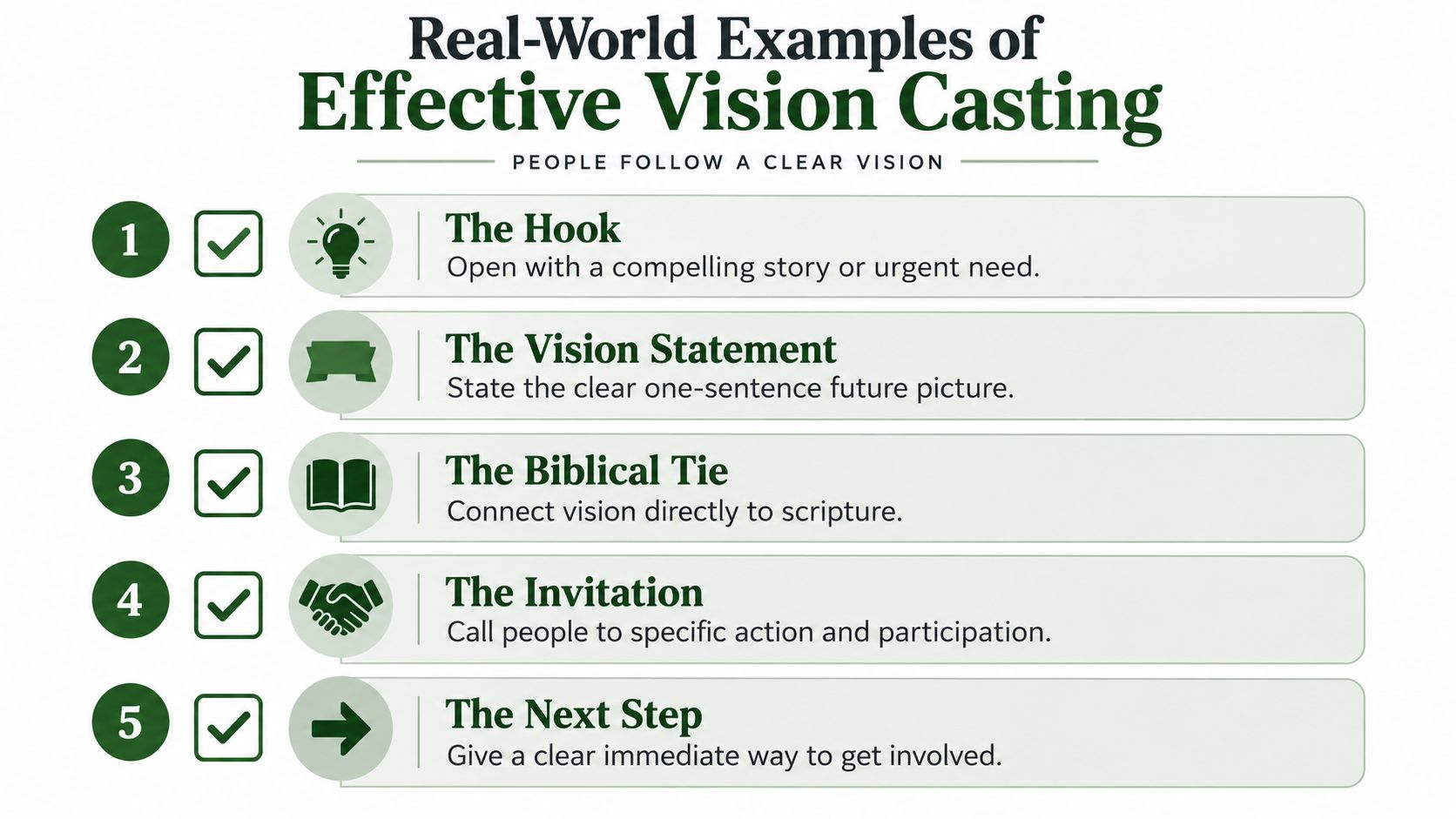
The hook begins with the member's story. The need feels personal rather than abstract.
The vision statement gives the congregation a concise future picture: “We are becoming a church where every person is known, discipled, and equipped to help someone else follow Jesus.”
The biblical tie connects the direction to the church's understanding of discipleship and shared ministry. Scripture isn't added as decoration. It explains why the future reflects the church's calling.
The invitation asks group leaders to identify one person they will intentionally disciple and asks members to join a group or help start one. The invitation turns emotional agreement into participation.
The next step gives people a clear immediate action, such as speaking with a group coordinator after the service or attending a leadership gathering. Leaders then follow up through meetings, stories, and written communication.
The finance team can support the same vision without making the message transactional. It can organize relevant expenses by fund, clarify available resources, and report whether designated gifts are being used as intended. Leaders can then discuss financial needs as part of the ministry story, explaining how resources help create the future they have described.
A short vision cast should remind people who they are, reignite why they exist, and refocus what they are doing. Sentergy's guidance on a short vision cast also emphasizes ending with one simple call to action. That simplicity protects the message from becoming a crowded list of requests.
The example works because the pastor doesn't ask volunteers to admire the vision. The pastor gives them a future to picture, a reason to care, a biblical foundation, and a specific way to participate.
Related church accounting software resources
If you are comparing software, these pages map the main decision points: fund accounting, QuickBooks limits, pricing, and migration.
- Best church accounting software (2026 comparison) - canonical guide comparing 12 church accounting platforms
- Church accounting software product page - see Grain Ledger for fund accounting, giving, and bank reconciliation
- Small church accounting software - see the product page built for volunteer treasurers and church admins
- Fund accounting features - review how Grain Ledger tracks designated funds
- QuickBooks for churches - understand workarounds and when to switch
- Free church accounting software - compare free options and upgrade triggers
- Grain Ledger pricing - compare plans for small and growing churches
- Start free - try fund accounting, giving imports, and bank reconciliation together
Moving From Inspiration to Operational Alignment
Vision casting becomes durable when the church treats it as a continuous loop rather than a launch event. Leaders communicate the future, listen to responses, make decisions, allocate resources, review progress, and communicate again. Each cycle helps the congregation see whether the stated direction is shaping real ministry.
A pastoral team can use this checklist during leadership meetings:
- Review the sentence: Can leaders state the desired future in language members understand?
- Check the decisions: Do recent governance decisions support the direction?
- Inspect the ministry calendar: Are programs and events reinforcing the same priorities?
- Review fund activity: Can the finance team show how restricted and unrestricted resources support approved work?
- Collect stories: What concrete examples help people see the vision becoming more present?
- Invite feedback: Where are members confused, discouraged, or ready to participate?
- Repeat the call: What single next step should the congregation take now?
The strongest churches don't separate spiritual leadership from operational discipline. Prayer and Scripture shape the direction. Stories and repeated communication help people embrace it. Decision architecture clarifies responsibility. Fund accounting helps leaders steward resources faithfully and report accurately.
Leadership test: The vision is taking root when it changes what the church celebrates, funds, schedules, measures, and invites people to do.
A church doesn't need a more impressive slogan. It needs a shared future that leaders can explain, ministry teams can practice, and finance teams can support with transparent records. When those pieces work together, vision casting moves beyond motivation and becomes a way to guide the congregation toward coordinated faithfulness.
Grain gives churches true fund-based accounting, with native fund architecture that connects giving platforms, bank accounts, transactions, and reports around the way congregations manage resources. Visit Grain to explore a clearer way to connect financial stewardship with your church's vision and ministry priorities.
Ready to simplify your church finances?
Start free with church fund accounting, or watch a product demo first.