
What Is Adjusting Entry
 By Gibson Brueher, Founder of Grain Ledger
What is adjusting entry. What is an adjusting entry? Learn how churches use accrual adjustments for restricted donations, prepaid expenses, and ministry assets
An adjusting entry is a period-end journal entry that converts cash-basis activity into accrual-basis reporting. It affects at least one income statement account and one balance sheet account, never cash, so the statements show revenue earned and expenses incurred in the correct period.
About Grain Ledger: This guide includes Grain Ledger, church fund accounting software built for designated gifts and ministry funds. It connects giving platforms (Planning Center, Pushpay, Tithely, Stripe), syncs bank activity with Plaid, and produces fund-level financial reports. Start free to see how it compares for your church.
See Grain Ledger for your church
Fund accounting, giving integrations, and bank reconciliation in one platform. Free migration support for churches switching from QuickBooks or Aplos.
You may be facing this on a Tuesday night after a busy month at church. The bank account looks balanced, but a utility bill hasn't arrived, a restricted donation is waiting for a ministry event, and insurance was paid months ago. If you report only what cleared the bank, the finance committee may see a distorted picture of ministry activity.
Adjusting entries correct those timing differences without rewriting the original transactions. They give your church a disciplined way to report what happened during the period, then trace each amount to the appropriate fund.
What Is an Adjusting Entry in Plain English
A simple definition of what is adjusting entry is this: it's a journal entry posted at the end of a reporting period to make the books reflect the activity that belongs in that period. The entry converts cash-basis activity into accrual-basis reporting, so financial statements recognize revenue when it's earned and expenses when they're incurred, even if cash moves earlier or later. Accounting guidance on adjusting entries describes them as an end-of-period step that involves an income statement account and a balance sheet account.
The two-account rule is your first safeguard. Every adjusting entry has equal debits and credits, and it normally touches:
- One income statement account, such as Utility Expense or Donation Revenue.
- One balance sheet account, such as Accounts Payable, Prepaid Insurance, or Deferred Revenue.
Adjusting entries never involve cash. Cash activity is recorded through a regular journal entry when money is received or paid. The adjustment records the economic activity that cash timing failed to capture.
Practical rule: If cash changes hands, record the cash transaction normally. If the period needs a better picture after that transaction, consider an adjusting entry.
Suppose the church uses electricity throughout December, but the utility bill arrives in January. The December service belongs to December, even though the payment belongs to January. At month-end, the treasurer can debit Utility Expense and credit Utilities Payable. The December statement then includes the expense, while the balance sheet shows the obligation.
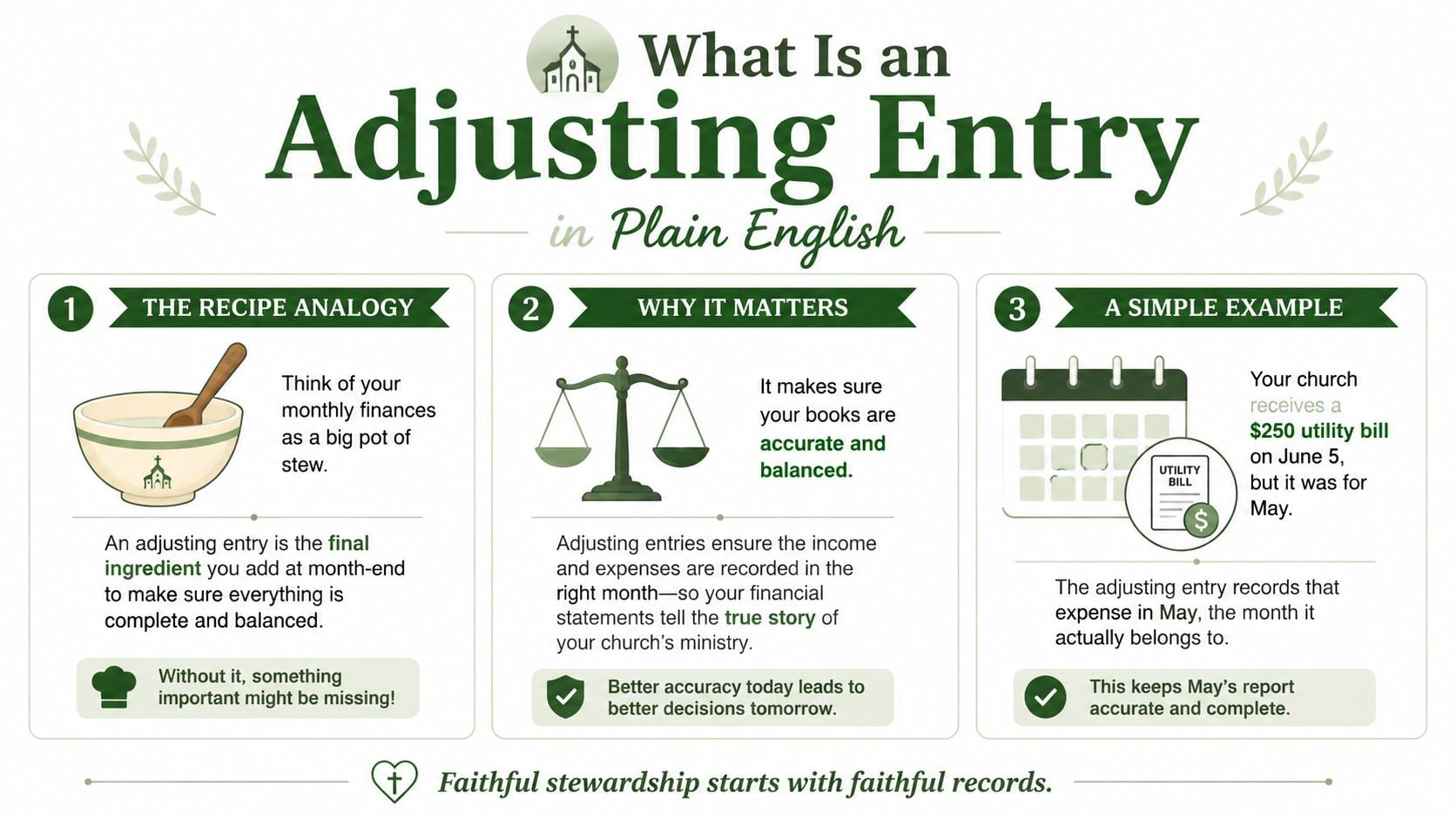
This same logic applies to restricted donations, pledged giving, prepaid insurance, unpaid payroll, and depreciation of ministry assets. The entry isn't a second payment or receipt. It's the final accounting step that places the activity in the correct period and fund before statements go to the pastor, board, or finance committee.
Why Adjusting Entries Matter Under Accrual Accounting
A church receives a donation on December 28, marked for January utilities. The bank statement shows December cash, but that date alone does not determine the accounting treatment. Cash-basis accounting asks, “What money entered or left the bank?” Accrual accounting asks, “What revenue was earned, and what costs were incurred during this reporting period?”
Modern reporting frameworks, including U.S. GAAP and IFRS, are built around accrual accounting. Revenue and expenses belong in the period when the related economic activity occurs, rather than automatically on the date cash changes hands. Learn more about accrual accounting and its reporting approach. AccountingCoach explains this period-end conversion, and you can read AmbitionCFO's accrual to cash guide for a further comparison of the two reporting views.
For the December donation, the treasurer must ask whether the funds are available revenue now or whether the restriction means the church should carry them as a liability until the related purpose is met. The answer depends on the restriction and the church's accounting policy. The bank date provides evidence of receipt, but it does not settle the reporting treatment.
| Account | Cash-Basis View | Accrual-Basis View |
|---|---|---|
| Cash | Record the receipt when the donation arrives. | Record the receipt when the donation arrives, then evaluate whether it belongs in deferred or restricted revenue. |
| Revenue | May show the entire receipt immediately. | Recognize revenue when earned or when the applicable restriction is satisfied. |
| Expense | Record January utilities when paid. | Recognize utilities in the period the church uses the service. |
| Fund balance | Can appear stronger before the related ministry cost occurs. | Reflects the restriction, liability, or earned activity more accurately. |
Adjusting entries connect the income statement with the statement of financial position. Deferred revenue keeps an advance receipt from appearing as current income before it is earned. An accrued expense records the obligation on the balance sheet while recognizing the cost in the period when the church used the service. The same timing discipline helps treasurers review pledged revenue, prepaid insurance, unpaid payroll, and depreciation of ministry assets without confusing accounting activity with cash movement.
Accurate adjustments support donor transparency, council reporting, stewardship decisions, and audit readiness. A reconciled checkbook can still accompany a misleading monthly ministry report. The treasurer therefore checks both records: the cash position and the economic activity assigned to each fund.
The Main Types of Adjusting Entries
Most adjusting entries fit into four recurring families, deferred expenses, accrued expenses, deferred revenues, and accrued revenues. Churches also rely on estimates, including depreciation, amortization, and allowances for amounts that may not be collected. This overview of adjusting entries explains the standardized structure behind these categories.
Accrued revenues
An accrued revenue entry records income the church has earned but hasn't yet received or billed. A December grant pledge is a practical example. The trigger is the church's right to the revenue based on work completed, an agreement, or an earned pledge.
The pattern is:
- Debit Pledges Receivable or another receivable account.
- Credit Pledge Revenue or the appropriate revenue account.
The income statement receives the earned revenue, and the balance sheet receives the receivable.
Prepaid expenses
A prepaid expense begins as an asset because the church paid for a future benefit. As the church consumes that benefit, the treasurer moves the applicable portion to expense.
The pattern is:
- Debit Insurance Expense, Rent Expense, or another applicable expense.
- Credit Prepaid Insurance or the related prepaid asset.
This avoids charging the entire payment to one month when the service covers multiple periods.
Unearned or deferred revenue
Deferred revenue applies when the church receives money before it has earned the revenue or before a related restriction is satisfied. The cash receipt is real, but the income statement shouldn't necessarily recognize it immediately.
The adjustment typically:
- Debits Deferred Revenue or Deferred Restricted Revenue.
- Credits the appropriate Revenue account when the earning or restriction event occurs.
The liability decreases as the church fulfills its obligation.
Accrued expenses
An accrued expense records a cost the church has incurred but hasn't paid or entered through an invoice. Utilities, payroll, and late vendor bills commonly create this need.
The pattern is:
- Debit Utility Expense, Salaries Expense, or the relevant expense.
- Credit Utilities Payable, Payroll Liabilities, or Accounts Payable.
For a deeper explanation of expenses owed but not yet paid, see Grain's guide to accrued expenses.
Estimates and depreciation
Some adjustments rely on a reasonable allocation rather than a newly received invoice. Depreciation spreads the cost of a long-lived ministry asset across the periods that benefit from its use. An allowance for doubtful pledges estimates the portion of receivables the church may not collect.
| Type | Trigger Event | Debit | Credit |
|---|---|---|---|
| Accrued revenue | Revenue earned before receipt or billing | Receivable | Revenue |
| Prepaid expense | Future service consumed | Expense | Prepaid asset |
| Deferred revenue | Advance receipt becomes earned | Deferred revenue | Revenue |
| Accrued expense | Cost incurred before payment or invoice | Expense | Payable |
| Estimate or depreciation | Asset use or collectability estimate | Expense | Accumulated depreciation or allowance |
Each category answers the same question: what belongs in this reporting period, and which asset or liability must show the related position?
Adjusting Entry Examples for Churches
Numbers become easier when the ministry story is clear. Each example below starts with the trigger, identifies the accounts, and shows how the entry affects the relevant fund.
Restricted donation for a future mission trip
A church receives a $5,000 restricted donation in December for a mission trip taking place in January. The receipt increases cash, but the church shouldn't automatically treat the amount as December unrestricted revenue. The initial entry is:
| Account | Debit | Credit |
|---|---|---|
| Cash | $5,000 | |
| Deferred Restricted Revenue | $5,000 |
When the restriction is satisfied in January, the reversing or recognition entry is:
| Account | Debit | Credit |
|---|---|---|
| Deferred Restricted Revenue | $5,000 | |
| Restricted Donation Revenue | $5,000 |
The cash belongs to the restricted fund from the start. The fund classification must stay attached through both entries, or the general fund may appear stronger while the mission fund is understated.
Pledged giving earned at month-end
The church has $12,000 of pledged giving that belongs in the current month, but the donors haven't paid yet. The adjusting entry is:
| Account | Debit | Credit |
|---|---|---|
| Pledges Receivable | $12,000 | |
| Pledge Revenue | $12,000 |
This recognizes the earned revenue and the receivable without pretending cash has arrived. The treasurer should tag the entry to the fund associated with the pledge. If the pledge is restricted, the revenue and receivable shouldn't disappear into an unrestricted operating account.
Prepaid insurance
The church pays $4,800 in July for six months of insurance coverage. The initial payment belongs in Prepaid Insurance. At each monthly close, the church recognizes $800 of coverage:
| Account | Debit | Credit |
|---|---|---|
| Insurance Expense | $800 | |
| Prepaid Insurance | $800 |
The adjustment reduces the asset as the church uses the policy. The expense should be assigned to the fund that benefits from the coverage, according to the church's allocation policy.
Depreciation of a church van
A church van costs $45,000 and is depreciated over five years. The monthly adjusting entry is $750:
| Account | Debit | Credit |
|---|---|---|
| Depreciation Expense | $750 | |
| Accumulated Depreciation, Building & Equipment | $750 |
The entry records the van's period-specific use without another cash payment. The depreciation expense should be associated with the ministry activity or fund that uses the vehicle, while the asset register should retain the van's identification and supporting calculation.
Allowance for doubtful pledges
The church estimates $600 of pledged receivables may not be collected. The adjustment is:
| Account | Debit | Credit |
|---|---|---|
| Bad Debt Expense | $600 | |
| Allowance for Doubtful Pledges | $600 |
This doesn't erase the pledge or change the donor record. It presents the receivable with a more cautious expectation of collection. The fund report should preserve the connection between the allowance and the pledge receivables it relates to.
| Scenario | Debit | Credit | Fund |
|---|---|---|---|
| Future mission trip donation | Cash, then Deferred Restricted Revenue on recognition | Deferred Restricted Revenue, then Restricted Donation Revenue | Restricted mission fund |
| Month-end pledged giving | Pledges Receivable | Pledge Revenue | Applicable pledge fund |
| Insurance consumed | Insurance Expense | Prepaid Insurance | Benefiting operating or ministry fund |
| Van depreciation | Depreciation Expense | Accumulated Depreciation | Vehicle-using ministry fund |
| Doubtful pledges | Bad Debt Expense | Allowance for Doubtful Pledges | Related pledge fund |
A Monthly Adjusting Entry Checklist for Churches
A dependable close doesn't require a large finance department. It requires a repeatable review, clear support, and a second person who can challenge unexplained entries.
Review before posting
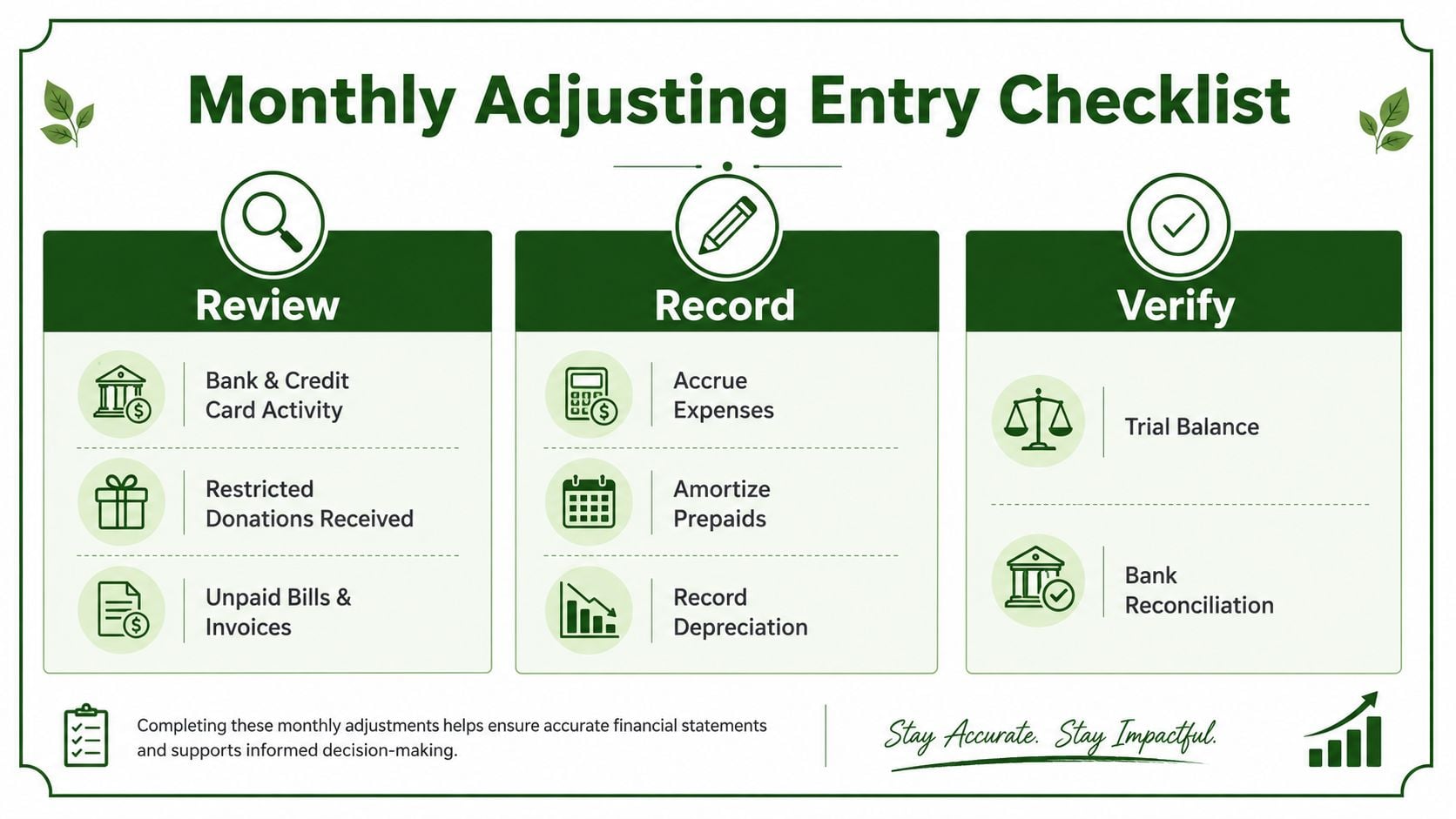
Print or save the unadjusted trial balance, then work through the source records:
- Review bank activity: Compare deposits and payments with the ledger.
- Review credit cards: Identify ministry purchases that belong in the closing period.
- Review restricted donations: Confirm every restricted receipt carries the correct purpose and fund.
- Review unpaid bills: Look for utilities, printing, repairs, salaries, and vendor invoices that arrived after close.
- Review prepaids: Check insurance and other paid-ahead services for the portion consumed.
- Review ministry assets: Identify vehicles and equipment requiring depreciation.
- Review payroll liabilities: Reconcile wages, withholdings, and employer obligations to payroll records.
Record the adjustments
Create separate double-entry journal entries rather than editing the original bank or invoice transaction. Attach the calculation, invoice, payroll summary, pledge support, insurance schedule, or asset record to each entry.
For accruals likely to be replaced by a normal transaction in the next period, mark whether a reversal is needed. That decision prevents the later invoice or payment from being counted alongside the accrual.
Verify the statements
After posting, run the adjusted trial balance and statement of financial position. Review activity by fund, not only in total, because a combined report can hide a restricted-fund error.
- Verify debits and credits: Confirm the entry balances.
- Verify fund tags: Check that the debit and credit belong to the intended fund.
- Verify reversals: Confirm next-period reversal dates and accounts.
- Verify classifications: Ensure liabilities, assets, revenues, and expenses appear in the right places.
- Obtain sign-off: Ask the treasurer or bookkeeper to approve the completed close.
Grain's fund-based ledger can tag adjustments to the originating fund, generate reversing entries on the first day of the next month, and provide fund-by-fund activity reports for finance committee review. The software should support the control process, not replace the treasurer's judgment.
Common Adjusting Entry Mistakes in Church Finance
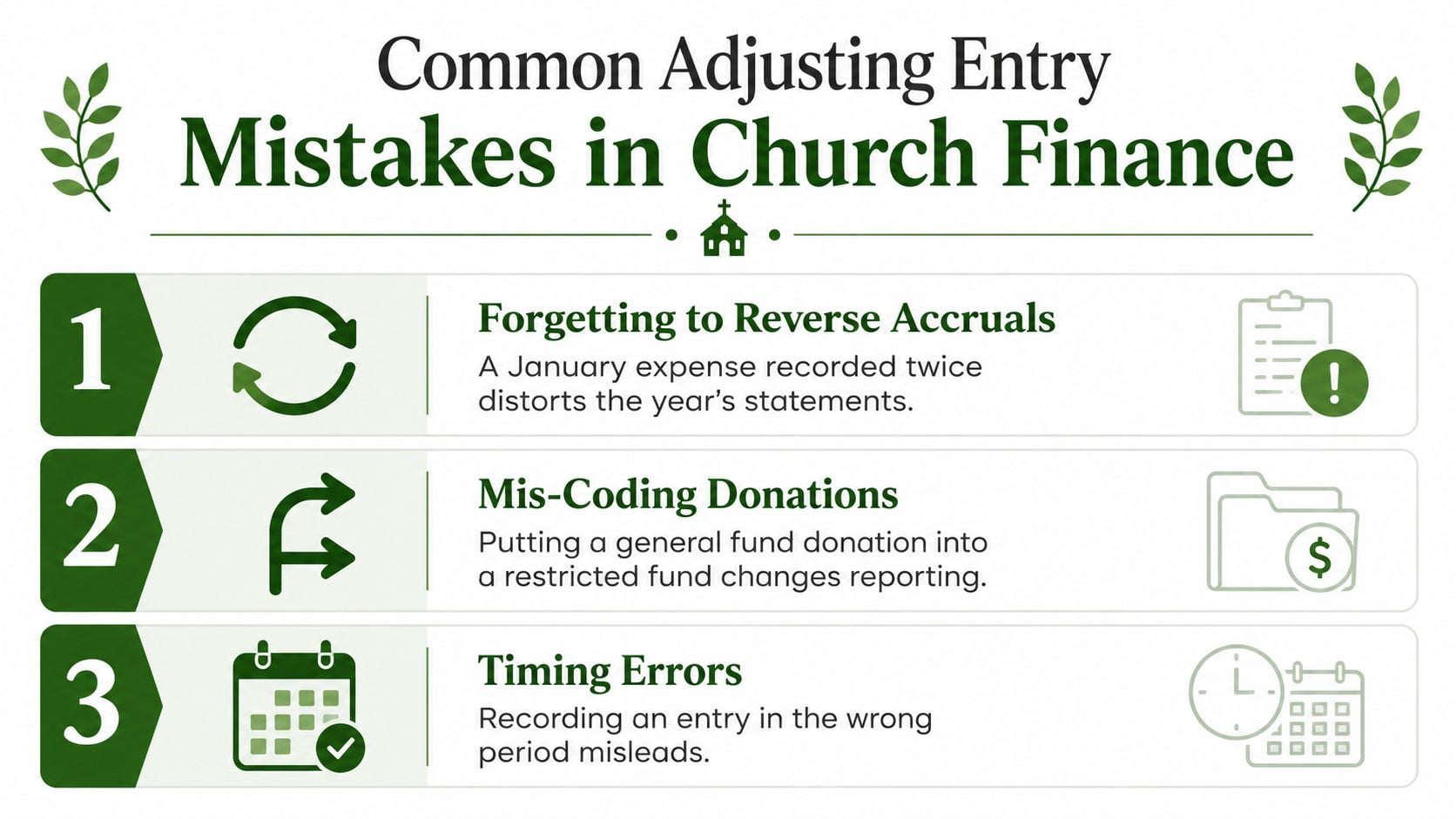
The most damaging mistakes often look harmless at posting time. A missing reversal can cause January expense to be recorded twice when the actual invoice arrives. That inflates the expense total and can make the operating result look weaker than it is.
Fund miscoding creates a different problem. If a general-fund donation is posted to the building fund, the total cash may still reconcile, but the fund balances and donor reporting won't. The same issue occurs when a restricted expense is charged to the general fund, leaving restricted resources apparently untouched while operating costs absorb the burden.
Other errors deserve a deliberate check:
- One-time treatment of prepaids: Expensing all prepaid insurance immediately overstates the current period's expense and understates the prepaid asset.
- Missing late invoices: Omitting a utility or printing invoice understates the current period's expense and payable.
- Improper depreciation: Donated land generally isn't depreciated because land isn't consumed in the same way as a depreciable ministry asset. The church should follow its accounting policy and document the classification.
- Netting activity: Combining revenue and expense into one net amount hides the separate flows needed for stewardship and fund reporting.
- Unreviewed estimates: An unsupported doubtful-pledge allowance can distort both receivables and expense.
The simplest guardrail is to attach support, select the correct fund, document the reversal decision, and review the adjusted trial balance before issuing statements.
Related church accounting software resources
If you are comparing software, these pages map the main decision points: fund accounting, QuickBooks limits, pricing, and migration.
- Best church accounting software (2026 comparison) - canonical guide comparing 12 church accounting platforms
- Church accounting software product page - see Grain Ledger for fund accounting, giving, and bank reconciliation
- Small church accounting software - see the product page built for volunteer treasurers and church admins
- Fund accounting features - review how Grain Ledger tracks designated funds
- QuickBooks for churches - understand workarounds and when to switch
- Free church accounting software - compare free options and upgrade triggers
- Grain Ledger pricing - compare plans for small and growing churches
- Start free - try fund accounting, giving imports, and bank reconciliation together
Bringing It All Together With Fund-Based Accounting
The month-end rhythm is straightforward:
- Record ordinary transactions during the month.
- Review timing differences before close.
- Post accrued, deferred, prepaid, estimated, and depreciation adjustments.
- Confirm every debit and credit carries the correct fund.
- Run the adjusted trial balance and statement of financial position.
- Approve the close and schedule required reversals.
The dual-account rule keeps the income statement and balance sheet aligned. Fund-based accounting adds another control dimension, because each side of the entry must also land in the fund that owns the activity. That is how a restricted balance stays separate from general operations while the church reports its full financial position.
Churches comparing systems can review Grain's fund-based accounting approach alongside their existing workflow. Grain Ledger is designed for church accounting with fund-aware journal entries, next-month accrual reversals, ministry asset tracking for depreciation, and a month-end approval workflow that brings the close into one reviewable process.
Grain connects church giving, bank accounts, cards, and accounting records so donations and adjusting entries can remain tied to the right fund. Visit Grain to Start Free and prepare a clearer, more controlled month-end close for your congregation.
Ready to simplify your church finances?
Start free with church fund accounting, or watch a product demo first.