Starter
For churches with up to $20k in monthly expenses
Free
- 1 Bank Account
- 3 Users
- Unlimited Funds
- Donor Insights
- 1 Active Budget
- Standard GAAP Reports
You run operations, not accounting. Grain Ledger gives you integrated spending visibility, department budgets, and board-ready reports without requiring you to manage the general ledger.
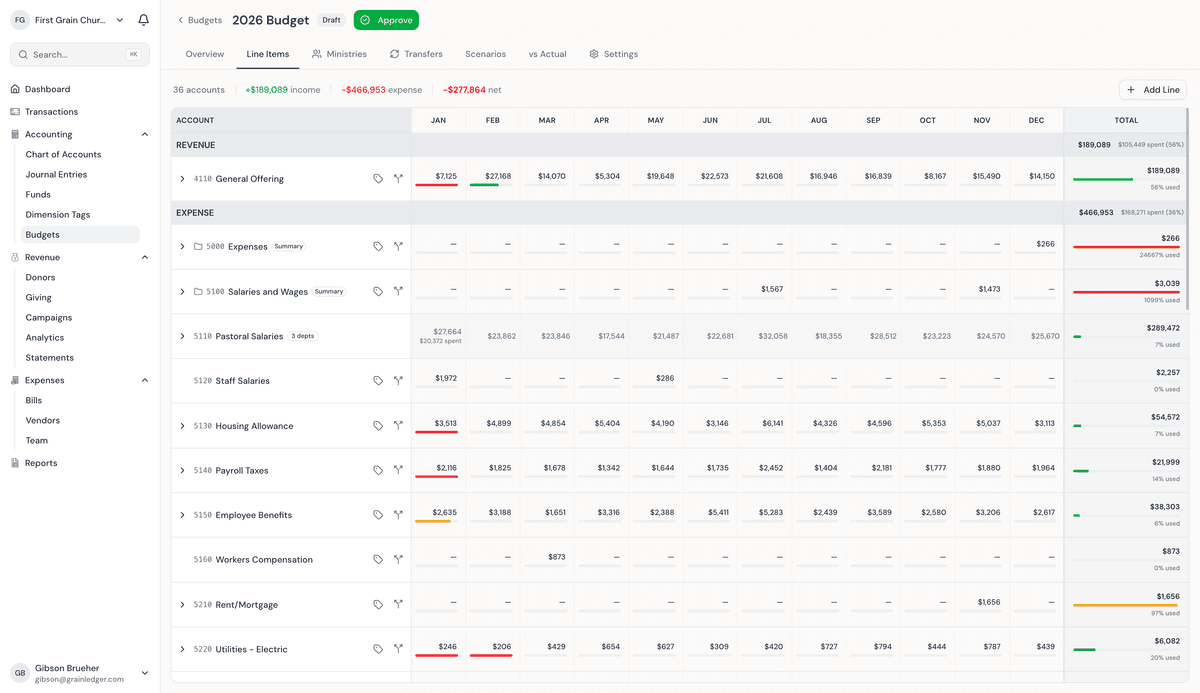
See Grain Ledger church accounting software for the full product overview, or compare accounting software for churches on fund balances, giving imports, and board-ready reporting.
If you're an executive pastor replacing spreadsheets, choose fund accounting software like Grain Ledger, which puts your part of church finance (each ministry's budget, the bills you approve, the report you take to the board) on the same books the treasurer keeps. A spreadsheet can't do that: it remembers each fund in a tab, with no balanced entry behind it. In Grain, the treasurer keeps the entries and you work from the same numbers. Starter is free for churches with up to $20,000 in monthly expenses, and Growth is $70 a month.
Six decisions land on your desk, and each one needs a number from the ledger.
| Your decision | What you need to see | Where it is in Grain |
|---|---|---|
| Set each ministry's budget | What each ministry spent last year | Budgets by fund, department or any dimension you tag, rolled up to ministry-level views |
| Decide whether a ministry is on track | Budget against actual, as the month goes | Budget vs. actual with real-time variance. Drill into any line to see what made the difference |
| Approve a bill | The invoice and the fund it will come from | Bills go through approval before they're paid, with a trail from invoice to payment |
| Commit money from a restricted fund | What's really left in that fund | Fund balance reports. Grain warns you when a bill or expense would take a restricted fund below zero |
| Answer the board's "why did this line move?" | The entries behind the number | Click any report number to see its journal entries and transactions. Export or present any report in one click |
| Plan next year's budget | This year's budget beside the proposed one | Unlimited active budgets on Growth. Proposed, approved and revised scenarios on Scale |
None of this asks you to enter a single transaction. Your login can be set up to match: it sees budgets and reports and approves bills, but it can't post entries. See how budgeting works in Grain.
The treasurer or a bookkeeper, with someone else checking their work. Your job is to supervise it. Tim Samuel, a CPA and CFO, puts it this way on XPastor: "A supervisor does not have to perform every financial task, but the supervisor should be able to ask questions that reveal whether responsibilities are clear and priorities are moving."
Approving bills can be yours: the United Methodist Church's finance agency (GCFA) says invoices must be approved by someone other than the financial secretary or treasurer, and that person should be authorized by the finance committee. In Grain, Starter has 3 users, and Growth and Scale have unlimited users. For the rest of the split, see our guide to segregation of duties.
A spreadsheet leaves someone to work out each fund's balance by hand. Owen Hill, a church treasurer and co-founder of Kleercard, describes exporting the balance sheet to Excel every month and subtracting every restricted balance by hand, so leadership can see what's truly spendable. Fund accounting keeps a balance for each fund from the moment money arrives.
Ramp's guide to church accounting software lays out the move in order: the chart of accounts, then fund mapping, the trial balance and the bank reconciliation, then running the old and new systems in parallel for at least one close. We'll help you make that move from spreadsheets, QuickBooks or Aplos at no charge, mapping your funds, accounts and opening balances with you, and every plan includes One-Click QuickBooks Migration. Our implementation guide covers the rest.
Your giving platform and church management system stay where they are. Grain is the finance ledger, and gifts import into it from the platform you already use. See all integrations.
Before you commit, close one real month on the free Starter plan. TechnologyAdvice suggests running that test with "the person most likely to perform the work, not only the software buyer", so let the treasurer or bookkeeper run the close. You check two reports: budget vs. actual and the fund statement for the board. Starter isn't a trial that expires, and it needs no credit card.
Your church's size picks the plan, not your title. Starter is for churches with up to $20,000 in monthly expenses, Growth ($70 a month) for up to $1 million a year in revenue or expenses, and Scale (from $100 a month) for anything larger. Growth connects 3 bank and card accounts. If you have more and you're under $1 million a year, connect the 3 you use most, or choose Scale for $30 a month more. Details are on the pricing page.
Grain Ledger is built to replace spreadsheet risk with fund accounting that scales.
See how each ministry is tracking against budget without chasing down expense reports from multiple department heads.
Planning Center for giving, Ramp for cards, Plaid for banking. Your tools talk to each other instead of generating exports you reconcile manually.
Pull financial summaries and drill into detail without depending on the treasurer to build a presentation every month.
Explore the product areas that match your needs, then start free or watch a short demo.
No credit card required. Most features are free for churches with up to $20k in monthly expenses.
For churches with up to $20k in monthly expenses
Free
For churches with up to $1M in annualized revenue or expenses
$70/month
Scale-based pricing for larger churches
From$100/month
+$50/month for each full $500k above $1M
 GrainPayroll
Pay your church staff and file payroll taxes, with every pay run posted to the right fund.
$50/month base
+ $10 per employee / month
Works with every accounting plan. No upgrade required.
Explore PayrollStarter
Growth
Scale
See how Grain Ledger gives executive pastors budget visibility and integrated reporting without the accounting overhead.